



Two traditions built on opposite answers to the same question: what does a garden owe to nature?
Formal French and informal English gardens are usually described as a matter of taste. They are better understood as a disagreement. One tradition holds that a garden demonstrates order imposed on nature. The other holds that a garden reveals nature already in order, with the designer's hand concealed. Almost every difference between them follows from that.
Gardening and landscaping are not the same discipline
Both work with plants, stone and ground, but they are separate practices. Gardening is the cultivation of plants. Landscaping is the design and construction of gardens and outdoor spaces, drawing on art and science to organise a site for aesthetic and practical ends at once. Landscape design carries the wider technical demand, covering levels, drainage, circulation and structure alongside planting, which is why the two traditions below are properly landscape arguments rather than horticultural ones.
How gardens became something to look at
Gardens began as utility. The oldest known form of horticulture is forest gardening, and early planting served the kitchen, the apothecary and the temple rather than the eye. Across history they have carried several roles at once.
Cultivation
The word garden derives from an enclosure, and the first were plots near a farmhouse, fenced to keep livestock away from the crop.
Shade
Wealthy Egyptians planted willow, date palm, fig, pomegranate and nut trees in straight rows, using the canopy to shelter more delicate planting beneath. Greek practice did something similar around temples and public spaces.
Religious observance
Egyptian temple gardens were consecrated to particular crops and herbs grown as offerings, and tomb paintings record produce presented to the gods.
Privacy
Walls and raised beds enclosed sixteenth century lawns, and monastic gardens were designed to shut out the world for contemplation.
Rest
Roman ornamental horticulture treated the garden as refuge from urban noise, a role that has survived every change of style since.
Status
The more elaborate the scheme, the more it said about the family paying for it. Wealthy Romans kept flowerbeds, shaded walks and fish ponds, and the same logic drives kerb appeal today.
The decorative garden proper emerges once there is a class with the leisure to enjoy it. Gardens began to be laid out for display in the thirteenth century, though the earliest surviving record of a deliberately designed garden is far older: a plan from Thebes, belonging to a high Egyptian court official, dating to roughly the fifteenth century BC, complete with notes on cultivation, sowing and grafting.
By the sixteenth century, European gardens were being cultivated for beauty as much as for food, with lawns and raised flowerbeds appearing around houses. Horticulture became an industry, and the books, journals and newspaper columns that followed built the audience that both traditions below were designed for.
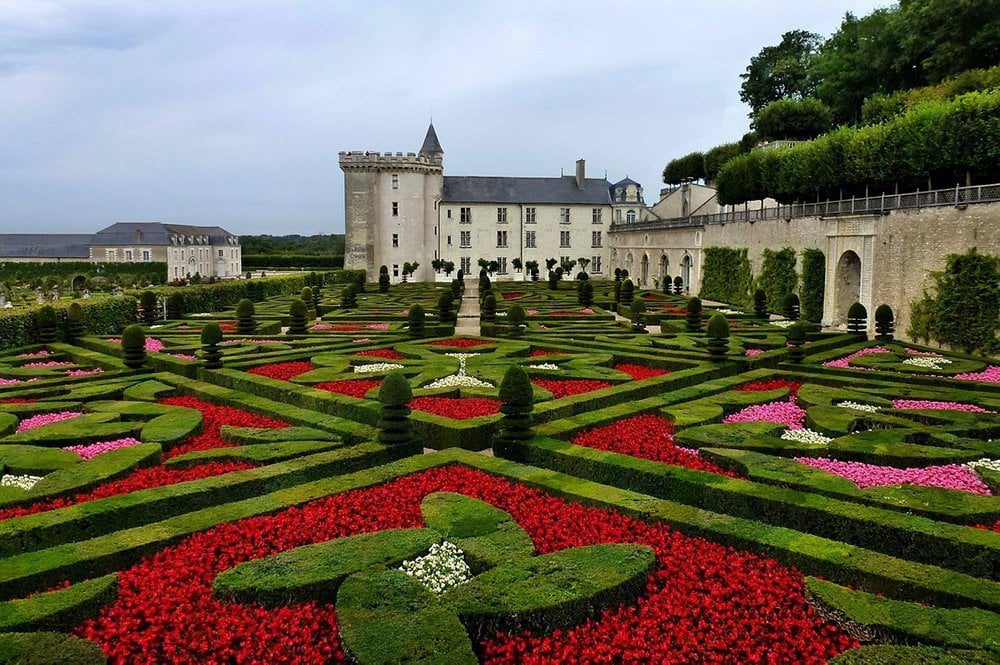
The French formal garden
The jardin à la française drew its foundations from the Italian Renaissance garden. Charles VIII returned from his Italian campaign in 1495 having seen what a garden could say about the ideals of an age, and brought Italian craftsmen and gardeners back with him.
What the French then developed went beyond the source. Italian Renaissance gardens were terraced and enclosed, organised as a series of separate compartments that did not always resolve into a single composition. The French unified the whole thing and tied it to the building.
The defining features follow from that ambition. Arrangement is symmetrical and ordered. Trees are planted in straight lines to establish perspective and reinforce the axis. The composition creates a long axial view outwards and frames the architecture of the house or château behind it. Planting is kept low near the building so nothing interrupts the view, with taller tree-edged paths further out. Fountains and cascades recur, and where they are correctly placed the reflected surface doubles the symmetry rather than competing with it.
The result holds together from a distance, which is the point. A formal French garden is composed to be read whole, from the terrace or the upper windows, rather than discovered on foot.

Château de Villandry shows the principle at domestic scale. The Gardens of Versailles show it at the scale of a state. Laid out by André Le Nôtre in the seventeenth century for Louis XIV, the gardens run to roughly 800 hectares and were the most significant in Europe, an argument in planting that peace and order arrive through man's rule over nature. Versailles was widely imitated across the courts of Europe through the later seventeenth and eighteenth centuries.
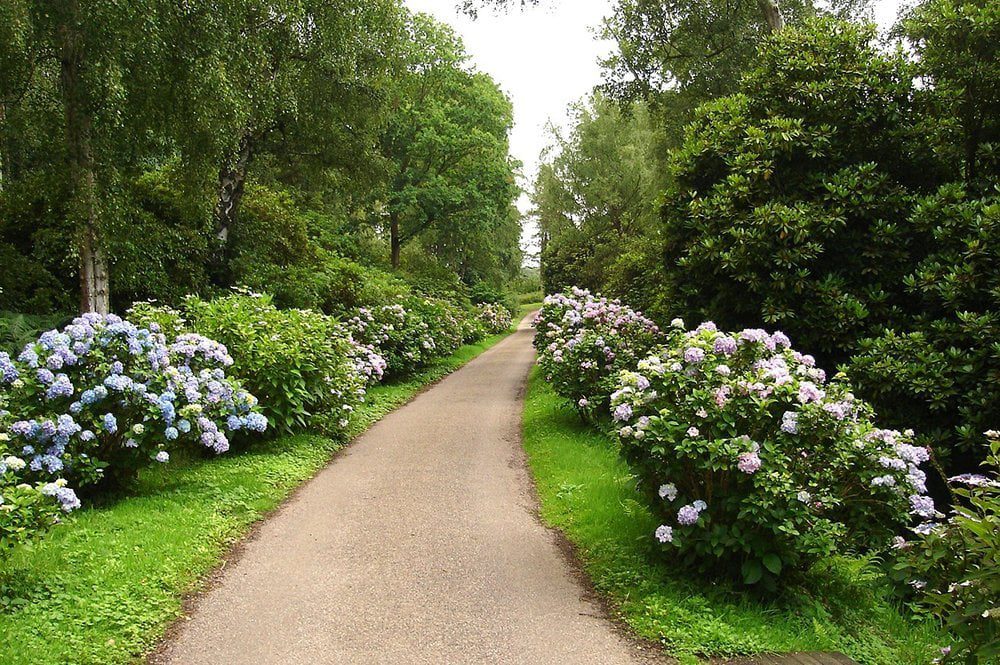
The English landscape garden
The English reaction began as an economic argument before it became an aesthetic one. In Ichnographia Rustica, his 1718 treatise on gardening, Stephen Switzer set the cost of maintaining formal gardens against an alternative that opened the garden to distant prospect and the expanse of nature itself, and argued it would serve both the individual and society better. It reads now as the opening statement of a movement.
The style became dominant through the eighteenth century, displacing the formal French garden in England. It was also the moment when science, philosophy and gardening intersected productively, with nature as the organising Enlightenment idea, a point the historian Roy Porter made central to his reading of the period.
The Far East supplied the model. Chinese garden practice prized abundance and irregularity, with tall trees and herbs arranged in unpredictable compositions, and Chinese observers were openly critical of the European habit of planting in straight lines. English designers took the lesson directly: geometry was abandoned, tree shaping was abandoned, and the objective became a landscape that appeared to have arrived without anyone's intervention.
William Kent and Capability Brown
Two figures did most to establish it. William Kent, an architect turned gardener, worked for the English aristocracy laying out serpentine walks with irregular woodland as the centrepiece, keeping only occasional straight paths.
Lancelot Brown, universally called Capability, worked at Stowe while Kent was consulting there before building the most influential career in eighteenth century landscape design. Brown's schemes are belts of trees around an entire estate, scattered planting, serpentine walks, wide lawns and irregular lakes with the occasional bridge, all composed to look grown rather than made. Croome Court was his first major commission, and his style outlasted him after his death in 1783, helped by an unusual ability to explain to clients exactly what they were buying.
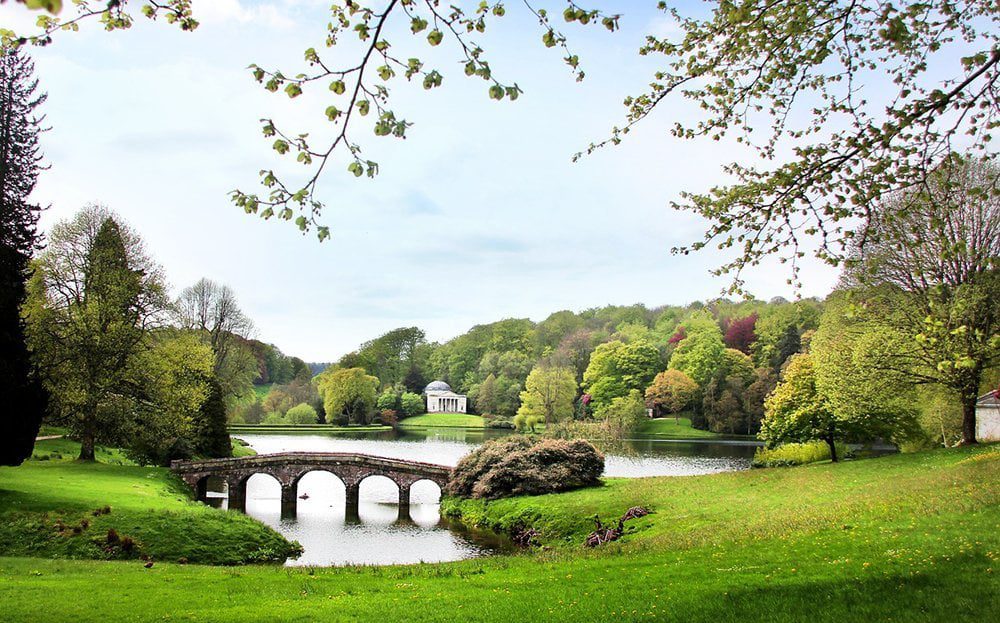
Stourhead in Wiltshire shows the same instinct from a different hand, laid out from 1741 by Henry Hoare with the architect Henry Flitcroft, a circuit walk around a lake staged as a sequence of views.
The English style travelled as thoroughly as the French one had. The jardin anglais in France and the Englischer Garten in Germany both descend from it.
What actually separates them
Set side by side, the differences resolve into four.
Relationship to nature
The French garden demonstrates control over it, the English garden conceals any control at all.
Geometry
Symmetry, axis and straight lines against curves, irregularity and the deliberate absence of a governing line.
How they are viewed
The French garden is composed for a fixed vantage point and reads best from a distance, the English garden is composed as a sequence and only works when walked.
Cost
English landscape gardens were less formal, less labour-intensive and considerably less expensive to establish and maintain, which is a large part of why the style spread as quickly as it did.
Neither tradition has disappeared. Formal geometry still does the work wherever a scheme needs to frame a building or hold a long view, and the landscape approach still governs how parks and larger public spaces are laid out. Most contemporary work borrows from both, using formal structure close to the architecture and letting the planting loosen as it moves away.
Where hardscape carries the argument
Both traditions depend on the ground plane to hold them together, and both are unforgiving of anything that breaks the composition. A formal scheme reveals every misaligned joint along its axis. A naturalistic scheme reveals anything that looks manufactured.
This is the case Jonite was founded on. Reinforced stone grates were developed to replace the metal grating that interrupts a designed landscape at exactly the moment it should disappear, made predominantly from natural aggregates, steel-reinforced for load, and available in a wide range of standard and custom colours so that a drainage line can be matched to its surroundings rather than announced. Get in touch with our team to discuss a custom finish for a scheme in either tradition.


