



A trench grate, also called a channel grate or trench drain, is a floor drain built around a long trough rather than a single point. Its job is to move surface water, and sometimes chemical spills, away quickly across a run rather than at one outlet.
They are everywhere once noticed: roadsides, car parks, pool surrounds, public toilets, schools, hospitals, hotels and domestic driveways. That ubiquity is part of the problem. Components seen this often tend to be specified from habit, and habit carries assumptions with it.
What the grate is actually doing
Before the assumptions, it is worth being clear about the work.
Managing volume
The grate is the intake for the whole drainage run. Where the open area is insufficient, water backs up at the surface regardless of how well the channel below is sized, which is how localised flooding starts on a system that looks correctly specified on paper.
Protecting the ground
Standing water degrades soil structure over time, and degraded soil erodes. Drainage that clears quickly protects the planting and the levels around it.
Keeping the system clean
Free-flowing drainage reduces the sediment and organic build-up that blocks channels. In tropical climates that also matters for public health, since standing water in a blocked channel is a mosquito breeding site.
The grate is purely functional
The oldest assumption, and the one that produces the most regrettable results. A trench grate sits in the finished floor, at eye level for anyone walking over it, and often runs the full width of an entrance or terrace. Few components are seen more and considered less.
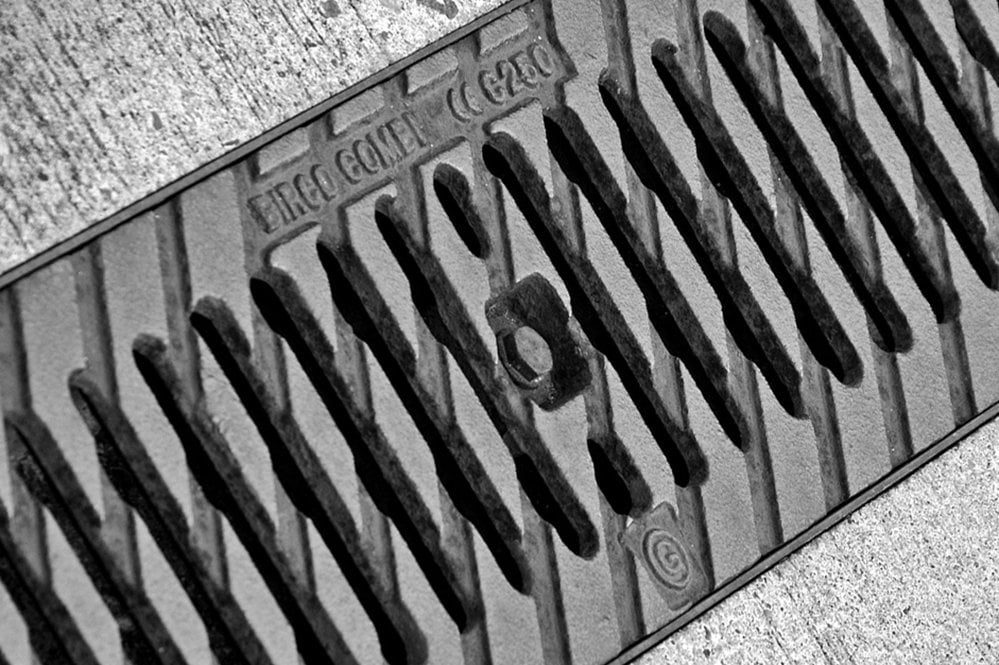
Treating it as invisible infrastructure means accepting whatever the drainage supplier offers, which is usually a galvanised or ductile iron grating in a pattern chosen for manufacture rather than for the scheme. The result interrupts a floor that has otherwise been carefully resolved.
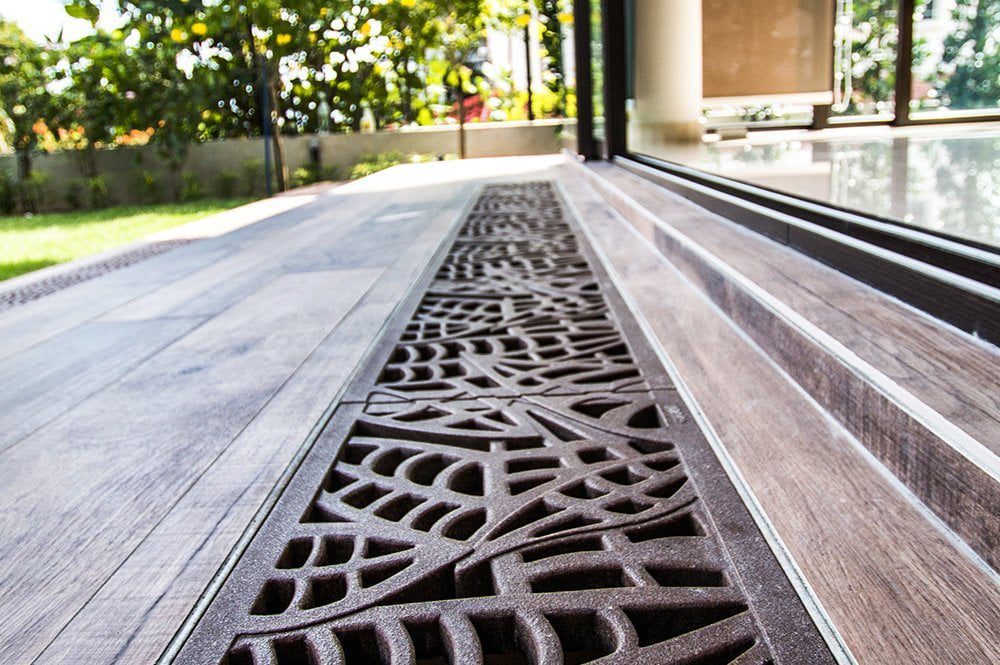
The alternative is not decoration for its own sake. It is matching the grate to the material around it so the drainage line reads as part of the floor rather than as a break in it.
Stone cannot carry the load
This one is understandable, since natural stone is strong in compression and weak in tension, which is exactly the wrong combination for a grate spanning a channel.
Reinforced stone is a different material. Jonite grates are steel-reinforced, which supplies the tensile strength that natural stone lacks, and are made from roughly 95% natural aggregates with at least 30% recycled content and less than 1% silica. Load performance is measured against the same standards as any other drainage grating, with BS EN 1433 setting the load classes from pedestrian areas through to heavy commercial traffic.
The practical point is that load class is a specification decision rather than a material one. A grate should be selected against the traffic it will actually take, and the material chosen from whatever meets that class.
Decorative means fragile
A variation on the same idea, and it survives because most decorative grating genuinely is a compromise, thin castings and pressed patterns that trade strength for appearance.
Reinforced stone separates the two. The pattern is formed in the component rather than applied to it, so a custom design does not reduce the section carrying the load. Surface finish does independent work as well, since a textured stone surface provides slip resistance underfoot, and the material resists staining and corrosion in ways that painted or coated metal does not over a long service life.
Sizing is standard and open area is a detail
Two assumptions that travel together, and both cost money when they go unexamined.
Sizes are not standard across the industry. Lengths, widths and frame details vary by manufacturer, and a grate specified against one supplier's module will not necessarily drop into another's channel. Where a scheme has an unusual channel width, a bespoke run is often simpler and no more expensive than forcing a stock size to fit.
Open area matters more than almost anything else on the drawing. The open-area percentage governs how much water the grate can accept, and a low figure will throttle a correctly sized channel beneath it. Two grates of identical dimensions can differ substantially here depending on the pattern, which is why the open-area percentage belongs in the specification alongside the load class rather than being left to the supplier.
Where this leaves a specification
Four questions cover most of it. What load will the grate take, and which class does that put it in. What open-area percentage does the drainage design require. What is the surface underfoot, and does it need slip resistance. And what should it look like in the floor it sits in.
Answer those in that order and the material choice tends to resolve itself. Get in touch with our team to discuss load class, open area and finish for a specific run, or request samples to see how a stone grate sits against a paving specification.


