



The backbone of any landscape, and how five common materials perform once they are in the ground.
As urbanisation intensifies, planting and landscape design have taken on greater weight in how cities are planned. The same instinct plays out at domestic scale, where a garden is prized as much for its structure as for what grows in it. In both cases, soft landscaping only reads as complete when the hardscape around it has been resolved with equal care.
Hardscape is the backbone of a planting plan. It creates spaces that serve a purpose while remaining pleasing to look at, and it works as the connective tissue between an outdoor garden and the interior it adjoins. Paths, patios, walls, timber structures and walkways all belong to it. Without that unifying structure, a garden tends to lack definition, however good the planting.
Why hardscape earns its place
Before choosing a material, it helps to be clear about what the hardscape is being asked to do.
Managing water
Paved surfaces direct rainfall towards designed drainage points rather than allowing it to pool or scour. Lawns, patios and driveways typically terminate at a channel or catch basin connected to an underground pipe, which is what keeps heavy rain from undoing the landscape around it.
Holding ground
Barriers of stone or concrete placed where erosion is likely will keep soil intact for years, removing the need to keep replacing material lost off a slope.
Protecting foundations
Hard surfaces at the perimeter of a building shed splash and runoff away from the structure, reducing the water ingress that leads to foundation problems over time.
Carrying traffic
A properly specified hardscape absorbs sustained footfall without breaking down, which expands the usable area of a site and keeps planted ground from being worn through.
Adding permanent fixtures
Decks and gazebos create activity space and shelter. Retaining walls do essential work on sloped sites, holding ground through heavy rainfall and making planting possible in places that would otherwise be unbuildable.
1. Wood, warmth at the cost of upkeep
 A hut made from raw wood lumber
Wood remains the most popular hardscape material, largely for its rustic character and the warmth it brings to a garden. It suits patios, gazebos, trellises and walkways, and it has one practical advantage that is easy to overlook: it conducts heat poorly, so it stays cooler underfoot in direct sun than most alternatives.
The trade-offs are real. Wood demands more maintenance than any other material here, and pricing varies widely with species and finish. It is a strong choice for fences, railings and the structure of garden buildings, and a weak one for outdoor flooring, where prolonged water absorption can cause warping, termites are a persistent risk, and exposure tends to discolour the surface.
2. Concrete, the affordable workhorse
 A wall covered with patterned concrete triangles
For a modern industrial character, concrete is difficult to beat on cost. It is the cheapest of the five, which is a large part of why it appears so widely in construction, and it is durable with it. The material can be moulded to almost any surface shape, which gives designers room to manoeuvre when budgets are tight, and it is unaffected by mould, pests and moisture.
Its weakness is thermal. Concrete absorbs and retains heat quickly, and a large expanse of it will raise the ambient temperature of the space around it. That matters most in tropical and subtropical climates, and least in shaded or temperate settings. It is most commonly specified for pavements, driveways and building claddings.
3. Brick, colour that holds
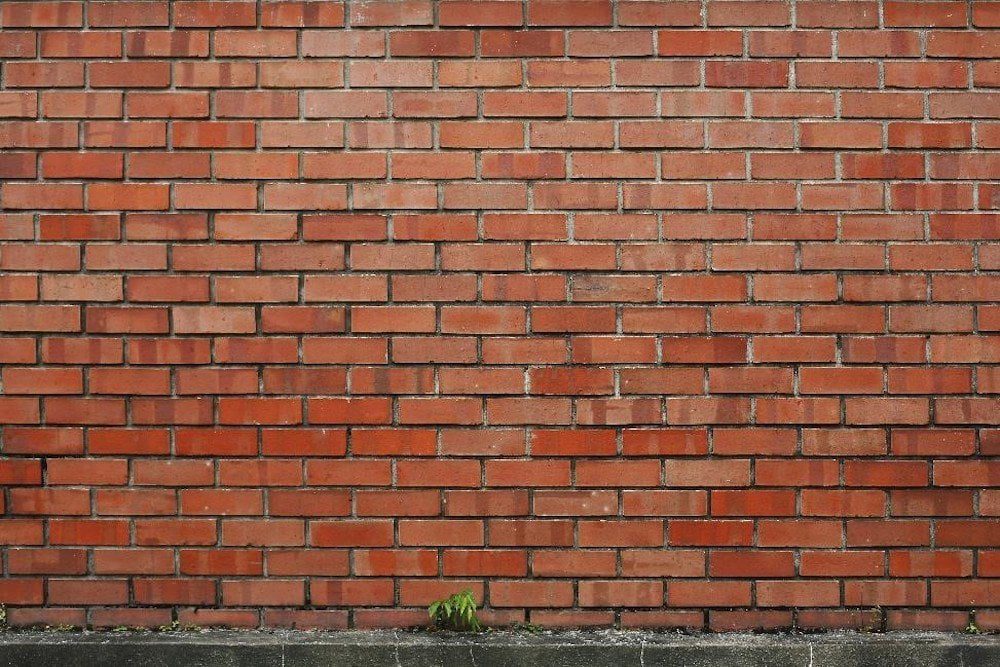
Brick delivers a neat, classic look with a sophistication that suits more mature schemes. Its great strength is colour retention: brick holds its tone through years of weathering in a way that painted and stained surfaces do not, and it is durable alongside that.
It is also unusually flexible for a permanent material, since brick can be lifted, reused and reset into new configurations rather than demolished. Its softer composition means it does wear under weather erosion over time, though for most designers that patina is part of the appeal rather than a fault. Brick works well in walls and pavements.
4. Tile, low maintenance with one caveat
 White tiles decorating a small courtyard
Tile is a mainstay of hardscape design, available in porcelain, ceramic, terracotta, quarry and mosaic forms. It is low maintenance, stain resistant, highly durable and versatile enough to move between horizontal and vertical applications, which is why elaborate tiling has become a favoured way to create a feature wall and give a scheme a visual focal point.
Two limitations are worth designing around. Glazed tiles become slippery when wet, so finish selection matters wherever water is present. Tile is also less able to drain water efficiently than the more open or textured materials here, which pushes the drainage strategy back onto falls and channels. It performs best across wide walkways.
5. Stone, durability measured in decades
 Jonite Trench Grate Nature collection
Stone has been building shelter since the Stone Age, and it carries the weight of that history in ancient Rome and in the castles of England. It is exceptionally weather resistant, which makes it among the most durable materials available for hardscaping, and it is naturally water resistant in a way that suits pools and water features.
Slip resistance is worth being precise about. Polished natural stone can be slippery when wet, and grip comes from the surface finish rather than from the material itself. Textured and honed finishes are what deliver traction, which is why engineered products are finished specifically for the purpose. Jonite's reinforced stone grates and panels are textured post-production for slip resistance, made from roughly 95% natural aggregates with at least 30% recycled content, containing less than 1% silica, and steel-reinforced to carry vehicular loads.
Installation asks more labour than most alternatives. That cost is usually recovered, since stone requires very little maintenance once it is down.
Choosing across the five
Design direction should drive material selection rather than follow it, and most schemes of any ambition mix several of these materials to achieve what a single one cannot. Wood where warmth is wanted underfoot, concrete where budget and form take priority, brick for colour that endures, tile for a focal surface, stone where the specification has to last.
It is also worth remembering that the market is not the limit. Materials suppliers will work with designers on custom solutions, often at budgets that are more accessible than expected.


